

Yes, IPTV is legal in the USA when the service has permission to distribute the channels, films, shows, and events it delivers. IPTV is only a way of sending television over an internet connection. The legal issue is the source: an authorized broadcaster, network app, virtual cable service, or personal media server is different from a seller retransmitting protected programming without the rights holder’s consent.
The difficult part is that an unlawful subscription can look polished. A functioning app, a long channel list, an app-store listing, or a successful payment does not prove that the operator holds U.S. distribution rights. This guide explains the federal rules that matter, the practical risks for viewers, and the checks you can complete before paying. It is general information, not legal advice for a specific dispute.
The United States does not treat “IPTV” as one licensed or forbidden product category. The same internet delivery method can carry a local station’s authorized stream, a paid virtual television package, a company training channel, personal videos, or an unauthorized copy of a premium broadcast. As a result, neither the letters IPTV nor the device used to watch it answer the legal question. The relevant facts are who controls the program, who sent the stream, what permission was granted, and where the viewer is located.
This article uses an evidence-first approach. Federal copyright guidance and public enforcement records explain the legal framework; provider identity, publisher records, written terms, payment details, and territorial availability help a consumer assess a particular offer. Marketing claims and channel totals receive less weight because they are easy to publish and difficult for a buyer to verify. A trial can confirm whether an app opens or a stream plays, but it cannot establish that the seller obtained permission from a broadcaster, league, studio, or other rights holder.
Content and licensing notice: Canadian IPTV Service does not host, transmit, sell, or supply television programming, playlists, login credentials, or access-control tools. This guide does not declare any unnamed provider lawful or unlawful and does not replace advice from a licensed attorney. Rights, platform policies, and service availability can change. Verify the responsible operator, the official application source, and authorization for the exact content and U.S. territory involved before subscribing or importing a playlist.
For a quick decision, use this rule: a normal app and a reliable picture prove only that the technology works. Legality requires a credible chain of permission from the rights holder to the distributor and then to the subscriber. When that chain cannot be identified, pause the purchase, ask precise questions, and choose an offer whose operator and terms can be independently checked.
The Short Answer: IPTV Technology Is Legal
Internet Protocol Television describes how video reaches a screen; it does not describe who owns the programming. U.S. households lawfully use internet-delivered television every day through network apps, authenticated cable apps, licensed live-TV bundles, free ad-supported channels, library services, and streams supplied by a rights holder. A player that opens an M3U playlist can also be lawful when the playlist contains personal media, public-domain works, or streams the user is authorized to access, whether watched on a television, phone, computer, or streaming device.
- Legal delivery: The operator has permission for the content, audience, and U.S. territory involved.
- Illegal delivery: The operator captures, copies, or retransmits protected programming without authorization.
- Neutral software: A television, player, playlist format, or streaming box does not establish content rights by itself.
What Makes an IPTV Service Legal in the United States?
A lawful service needs authorization from the people or companies that control the programming it offers. Those rights can be limited by country, platform, subscription tier, viewing method, and time period. A distributor allowed to show a channel in one market may not have permission to sell it nationwide in the United States. That is why a broad statement such as “IPTV is legal” cannot verify a particular subscription.
- Identifiable operator: A real company or accountable organization is named in the terms, privacy notice, and billing record.
- Distribution authority: The service can explain who supplies or licenses the channels and on-demand works.
- Territorial availability: The offer is authorized for the viewer’s U.S. location, not merely accessible there.
- Normal consumer terms: Price, renewal, cancellation, device limits, and refunds are written before checkout.
Which U.S. Copyright Rules Apply to IPTV?
Federal copyright law gives rights holders control over activities that can include reproducing, distributing, and publicly performing protected works. Unauthorized streaming can implicate the public-performance right, while making server copies may implicate reproduction. The U.S. Copyright Office has explained that retransmitting a live broadcast or prerecorded work over the internet without permission can infringe copyright. The precise claim and remedy depend on the facts.
The Digital Millennium Copyright Act also matters. Among other provisions, it created notice-and-takedown procedures and restricts circumvention of technological protection measures. The Copyright Office gives bypassing a password system used to control access to a streaming service as an example of conduct addressed by the anticircumvention rules. Installing a normal player is not circumvention, but defeating access controls is a separate legal concern.
Legal IPTV vs Illegal IPTV at a Glance
| Check | More consistent with an authorized service | Reason for caution |
|---|---|---|
| Operator | Named company, address or accountable support route | Seller exists only in an anonymous chat account |
| Content rights | Availability and network relationships are described | Every premium channel is promised with no rights explanation |
| Applications | Official publisher pages and verifiable developer identity | Unknown APK files sent through disappearing download links |
| Billing | Documented checkout, renewal, cancellation, and receipts | Gift cards, cryptocurrency only, or changing payment names |
| Price | Terms broadly reflect the programming and service supplied | Lifetime access to huge premium catalogs for a token fee |
| Support | Written policies and consistent contact details | Pressure tactics, evasive answers, or instant account deletion |
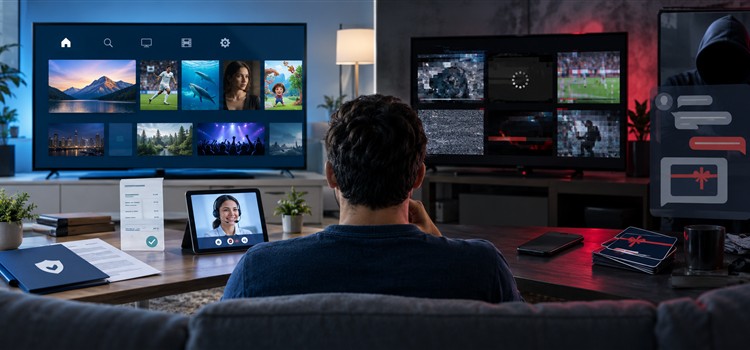
No single row proves legality. A lawful provider may use a small support team, and a polished website may still sell unauthorized access. Treat the table as a screening tool, then look for evidence connecting the operator to the programming it offers.
Can a Viewer Get in Trouble for Watching Illegal IPTV?
A subscriber should not assume that enforcement against operators makes unauthorized viewing harmless. Copyright exposure is fact-specific, and conduct such as redistributing streams, sharing credentials, recording and reposting protected works, selling access, or bypassing access controls can create additional risk. Civil disputes use different standards from criminal prosecutions, so “viewers are never targeted” is too broad to be reliable advice.
The Protecting Lawful Streaming Act was directed at willful, commercial-scale illegal streaming services rather than ordinary lawful users. U.S. prosecutions illustrate that operational conduct is a central enforcement focus. In one Department of Justice IPTV case, prosecutors alleged that defendants fraudulently obtained television accounts and resold copyrighted programming to thousands of subscribers. An indictment is an allegation, but the case shows why a reseller’s source matters.
The Practical Risks Often Arrive Before a Lawsuit
For many customers, the immediate danger is financial or technical rather than a courtroom. An unauthorized service can lose its domain, payment account, server, or upstream stream without warning. A prepaid “lifetime” plan can disappear overnight. The operator may hold a subscriber’s email address, device identifier, viewing history, and payment information while offering no accountable privacy contact or reliable refund route.
- Service loss: Accounts and prepaid terms can become worthless after a shutdown or domain seizure.
- Payment exposure: Unfamiliar processors and irreversible methods can make a dispute difficult.
- Malware risk: Unverified apps may request permissions unrelated to video playback.
- Privacy risk: Anonymous sellers may provide no meaningful data-retention or deletion process.
- Household disruption: Streams, guides, support, and credentials may fail without notice.
How to Check Whether an IPTV Provider Is Authorized
Begin with identity, then move to rights. Record the legal or trading name, official domain, app publisher, customer-support address, and checkout descriptor. Compare those details across the website, privacy policy, terms, app listing, and payment page. If different businesses appear at each step, ask for a written explanation before providing money or personal information.
- Name the seller: Find the business responsible for the subscription and the entity taking payment.
- Check the publisher: Match the official app developer and linked website to the seller.
- Ask about rights: Request a specific answer for major networks, sports packages, and U.S. availability.
- Read the contract: Save the current renewal, cancellation, refund, device, and simultaneous-stream terms.
- Verify independently: When possible, check the network or rights holder’s authorized-provider information.
Warning Signs of an Unlicensed or Unsafe IPTV Offer
Marketing language is not evidence. Phrases such as “one hundred percent legal,” “private servers,” or “works everywhere” do not identify a license. Be especially careful when a seller promises virtually every U.S. premium network, pay-per-view event, regional sports feed, international channel, and new film under one extremely cheap plan but cannot name the responsible business.
- Anonymous ownership: No company identity, jurisdiction, stable contact, or verifiable billing name appears.
- Implausible catalog: Competing premium packages are bundled together without any licensing explanation.
- Pressure selling: Support demands immediate payment, discourages questions, or changes prices privately.
- Unsafe installation: The seller requests broad device permissions or supplies files from unrelated domains.
- No exit route: Refund, cancellation, renewal, and dispute terms are missing or contradictory.
Are IPTV Players, M3U Lists, and Streaming Boxes Legal?
Usually, the tools and formats are neutral. An IPTV player can organize live streams and on-demand items without supplying any programming. M3U is a playlist format, and a streaming box is a general-purpose device. Each can be used with authorized subscriptions, free-to-air sources, personal recordings, workplace video, educational material, or a home media server. Our guide to what IPTV is and how it works separates the delivery system from the content source.
The legal question changes with the source loaded into the tool and the actions taken. A player listing in a recognized store can improve confidence in the software’s publisher, but the store does not necessarily review every playlist a user later imports. Likewise, owning a box does not authorize protected streams, and a preloaded box can be risky if its seller will not identify the content supplier.
Does a VPN Make IPTV Legal?
No. A virtual private network can encrypt traffic between a device and the VPN server, but it does not grant distribution rights or convert an unauthorized stream into an authorized one. Privacy technology and copyright permission answer different questions. A VPN may also conflict with a lawful platform’s location rules, household policy, or terms, so read those conditions before using one with a subscription.
- Privacy is not permission: Concealing an IP address does not create a content license.
- Location rules remain: A service may limit viewing to licensed territories or a verified home network.
- Terms still apply: Account sharing, simultaneous streams, and device rules remain enforceable contract conditions.
- Security has limits: A VPN cannot make a malicious app or dishonest payment page trustworthy.
Paying for IPTV More Safely in the USA
Authorization should come first, but payment terms offer another important check. Prefer a short, clearly documented plan from an accountable operator. Read the total charge, taxes, trial conversion, renewal date, cancellation method, and refund conditions before submitting payment. Confirm whether extra screens or sports packages change the price. The Federal Trade Commission advises consumers to understand when a free trial ends, how to cancel, and what an automatic renewal will cost.
- Keep evidence: Save the offer, terms, cancellation instructions, receipt, and support conversation.
- Avoid irreversible pressure: Gift-card demands and urgent off-site payments are strong scam indicators.
- Start briefly: Do not treat a deep long-term discount as proof of legitimacy or stability.
- Review statements: Check for unfamiliar descriptors, duplicate charges, and unexpected renewals.
What to Do If You Suspect Your IPTV Service Is Illegal
Stop adding money or devices while you verify the operator. Preserve receipts, the advertised terms, the domain, the app publisher, and written support responses. Do not redistribute the stream, share credentials, or install replacement files sent through an anonymous message. Remove software that came from an unverified source, review its permissions, change any reused password, and monitor the payment method connected to the account.
If a charge was unauthorized or the seller misrepresented the transaction, contact the card issuer or payment provider through its official channel and explain the facts accurately. A consumer can also report suspected fraud to the FTC. Copyright or contract questions tied to a notice, subpoena, demand letter, resale activity, or substantial financial loss deserve advice from a qualified U.S. attorney who can review the actual documents.
Verdict
IPTV is legal in the USA when the operator is authorized to deliver the programming to the viewer’s location. The protocol, app, M3U file, or television box does not decide legality on its own. The decisive evidence is accountable identity, territorial distribution rights, a trustworthy application source, and clear consumer terms. If a seller cannot connect its enormous premium catalog to any identifiable rights arrangement, do not let a working trial substitute for proof.
Choose services you can verify, keep dated records, and avoid long prepaid commitments while questions remain. For a comparison built around licensing transparency and consumer checks, see our guide to legal IPTV provider options. Availability can change, so recheck the official offer and U.S. territorial terms at the time you subscribe.
FAQs
Is IPTV illegal in every U.S. state?
No. IPTV is a lawful delivery technology used by licensed services nationwide. Federal copyright rules are central to unauthorized retransmission, while state contract, fraud, privacy, and consumer-protection laws may also matter. The facts of the service, the programming, the viewer’s conduct, and the transaction are more important than the IPTV label.
How can I tell whether an IPTV service has U.S. rights?
Identify the operator, app publisher, and billing entity; read its terms; and look for specific information about networks, territories, and authorized availability. Ask the service to explain rights for important programming, then verify through the relevant network or rights holder when possible. Keep the answer in writing.
Is a cheap IPTV subscription automatically illegal?
No single price proves infringement. However, an extremely low fee combined with every premium network, new films, major sports, anonymous ownership, and no licensing explanation is a serious warning pattern. Evaluate the complete offer, seller identity, and payment terms rather than relying on price alone.
Are free IPTV streams legal in the USA?
Some are. Broadcasters, government bodies, rights holders, and free ad-supported services can lawfully offer streams at no charge. A third party restreaming protected channels without permission is different. Free access, an embedded player, or a public web address does not prove authorization, so verify the source and publisher.
Can I legally use an IPTV player on Firestick or Android TV?
Yes. A player is generally software for opening playlists or account streams. Use the official developer source, review permissions, and connect only programming you own or are authorized to access. Sideloading does not itself prove illegality, but it increases the need to verify the file, publisher, update channel, and content source.