

Yes, IPTV is legal in Canada when the service has the proper rights to distribute the content it offers. IPTV itself is only a technology. It delivers TV channels, movies, shows, and other video content through an internet connection instead of traditional cable or satellite. The legal problem starts when a service streams copyrighted channels, live sports, movies, or pay-per-view content without permission from the rights holders.
From my experience reviewing IPTV services and streaming setup guides, this is where most users get confused. They hear “IPTV” and assume it is either fully legal or fully illegal. That is not how it works. The real question is not whether IPTV is legal. The real question is whether the IPTV provider is licensed, transparent, and allowed to distribute the content it sells.
Important note: This article is for informational and educational purposes only. It is not legal advice. If you are dealing with a legal notice, reseller issue, business setup, or copyright claim, speak with a qualified Canadian lawyer.
Quick Answer: Is IPTV Legal or Illegal in Canada?
IPTV is legal in Canada when it is offered by a legitimate provider that has permission to stream the content. This includes properly licensed TV providers, official streaming apps, legal video-on-demand platforms, and services that distribute content they own or have rights to use.
IPTV becomes illegal when a provider restreams copyrighted channels, movies, sports events, or premium content without authorization. This can include cheap “all channels” subscriptions, private sellers on social media, preloaded boxes, or apps that promise premium content at unrealistic prices.
| Type of IPTV Use | Legal Status in Canada | Why It Matters |
|---|---|---|
| Licensed TV service using IPTV technology | Legal | The provider has distribution rights and follows Canadian rules. |
| Official streaming apps and legal video platforms | Legal | The content is offered directly by rights holders or authorized partners. |
| Free ad-supported streaming channels | Usually legal | Legal when the platform has permission to show the content. |
| Unverified IPTV seller offering thousands of premium channels | High risk | The provider may not have rights to the channels or events. |
| Preloaded IPTV box with pirated streams | Likely illegal | The device may be legal, but the unauthorized streams are the problem. |
| Reselling unlicensed IPTV subscriptions | Illegal risk is very high | Resellers can be exposed to copyright claims and enforcement action. |
What Is IPTV in Simple Terms?
IPTV stands for Internet Protocol Television. It means TV content is delivered through the internet. Instead of receiving channels through a cable line or satellite dish, you watch through an app, smart TV, set-top box, streaming device, phone, tablet, or browser.
IPTV can include live TV, video on demand, catch-up TV, replay features, electronic program guides, and multi-device viewing. In daily use, it feels similar to streaming. You click what you want to watch, and the content plays through your internet connection.
The technology is not the issue. The same delivery method can be used by a legal telecom provider or by an illegal pirate service. That is why judging IPTV only by the app, playlist format, or device is a mistake. The source of the content matters more than the technology.
Why IPTV Legality Depends on Content Rights
Think of IPTV like a delivery truck. The truck itself is not illegal. It depends on what is inside and whether the sender has the right to deliver it. IPTV works the same way. A provider needs permission to distribute the channels, shows, films, sports, and premium content it offers.
In Canada, copyright owners have rights over how their content is copied, distributed, communicated, and made available. If an IPTV service streams protected content without permission, it can create copyright problems. This is especially serious when the service is built mainly to provide unauthorized access to paid channels or premium events.
For users, the safest approach is simple: choose services that are transparent about who they are, what they provide, how they charge, and how they obtain content rights. Mystery sellers and “too good to be true” offers are not a bargain. They are usually the streaming version of buying sushi from a van with no license plate.
Legal IPTV vs Illegal IPTV in Canada
The difference between legal and illegal IPTV is not always visible from the app screen. Many illegal services look polished. Some even have websites, trials, and customer support. That does not automatically make them legal. You need to look at the provider behind the service.
| Factor | Legal IPTV Service | Illegal or Risky IPTV Service |
|---|---|---|
| Content rights | Has permission to distribute content | Streams channels or events without clear rights |
| Business identity | Clear company details and support channels | Anonymous seller or constantly changing domain |
| Pricing | Realistic pricing based on content and service quality | Very low price for massive premium access |
| Payment methods | Uses normal payment options and clear billing | Crypto-only, gift cards, or informal transfers |
| Apps | Uses official apps or approved platforms | Requires unknown APKs or unsafe sideloading |
| Terms | Has terms, privacy policy, refund policy, and support | No clear terms or vague claims |
| Stability | Reliable service with accountable support | Frequent shutdowns, broken links, and server changes |
What Canadian Law Says About IPTV
Canadian law does not ban IPTV technology. In fact, IPTV is a recognized way to deliver TV services. The issue is whether the service follows broadcasting rules, copyright requirements, and content licensing obligations.
1. CRTC and IPTV Services
The Canadian Radio-television and Telecommunications Commission, known as the CRTC, regulates broadcasting and telecommunications in Canada. IPTV can be used by legitimate TV service providers to deliver digital channels through a high-speed internet connection.
Some online video services operate differently from traditional TV providers. Canadian rules have also changed through the Online Streaming Act, which modernized the Broadcasting Act for online streaming services. This does not mean every small IPTV website is automatically legal or licensed. It means the regulatory picture depends on the type of service, its scale, and its role in distributing content.
2. Copyright Act and Unauthorized Streaming
The Copyright Act is central to IPTV legality. If a provider streams content without permission from the copyright owner, that can create infringement issues. This is especially relevant for live sports, premium movies, pay-per-view events, specialty channels, and international broadcasts.
Services that are mainly designed to enable copyright infringement are especially risky. If the business model depends on giving users unauthorized access to protected content, the provider is standing on very thin ice. In Canada, thin legal ice is still ice, and it can crack fast.
3. Notice and Notice Regime
Canada has a Notice and Notice system for alleged online copyright infringement. Under this system, a copyright owner can send a notice to an internet service provider, and the provider may forward that notice to the subscriber linked to the IP address involved.
Receiving a notice does not automatically mean a court has found you guilty. It also does not mean you must immediately pay money to the sender. However, it should not be ignored casually. It is a warning that your internet connection may have been linked to alleged infringing activity.
Can You Get in Trouble for Watching Illegal IPTV in Canada?
Most enforcement attention usually focuses on operators, sellers, resellers, and distributors rather than ordinary viewers. That said, using illegal IPTV is not risk-free. A user can still face service loss, privacy exposure, malware, payment scams, and possible legal complications if a copyright owner takes further action.
The realistic risk is higher if you are selling subscriptions, promoting a pirate service, running servers, managing reseller panels, modifying boxes for others, or collecting payments. A casual viewer may face lower practical enforcement risk, but lower risk does not mean legal approval.
My advice is direct: do not build your entertainment setup around a service you would be embarrassed to explain to your internet provider, payment company, or a lawyer. That is a good gut-check.
Are IPTV Boxes Legal in Canada?
An IPTV box, Android TV box, Fire TV device, or smart TV app is not automatically illegal. Devices are tools. You can use them to watch legal apps, free channels, paid streaming platforms, or your own media files.
The legal issue appears when the device is sold or configured mainly to access pirated streams. A “fully loaded” box that comes with unauthorized premium channels, live sports, and pay-per-view access is risky. The box may look harmless, but the content source can be the problem.
- A normal streaming device is legal.
- An IPTV player app is legal when used with authorized content.
- An M3U playlist is legal when the playlist contains lawful streams.
- A preloaded piracy box or unauthorized subscription is risky and may be illegal.
Is an M3U Playlist Legal in Canada?
An M3U playlist is just a file format. It can contain links to video streams, radio streams, or live channels. The format itself is legal. The content inside the playlist decides the risk.
If the playlist contains your own streams, public legal streams, or content from an authorized provider, it can be legal. If the playlist contains premium TV channels, paid sports, movies, or subscription content without permission, it becomes a problem.
Do not judge an IPTV setup only by whether it uses M3U or Xtream Codes. Those are access methods. They do not prove licensing.
Does a VPN Make IPTV Legal in Canada?
No. A VPN does not make illegal IPTV legal. A VPN can improve privacy, reduce exposure on public Wi-Fi, and help protect your browsing data from some forms of tracking. But it does not give an IPTV provider permission to stream copyrighted content.
This is one of the biggest myths in IPTV. A VPN changes how your traffic is routed. It does not change copyright law. If the stream is unauthorized, hiding your IP address does not magically turn it into licensed content.
Use a VPN for privacy if you choose to, but do not treat it as a legal shield. It is a privacy tool, not a copyright permission slip.
How to Check If an IPTV Service Is Legal in Canada
There is no single button that proves an IPTV service is legal. Still, you can reduce risk by checking practical signs before subscribing. The goal is to verify whether the provider behaves like a real media service or like a disposable pirate operation.
Use This IPTV Legality Checklist
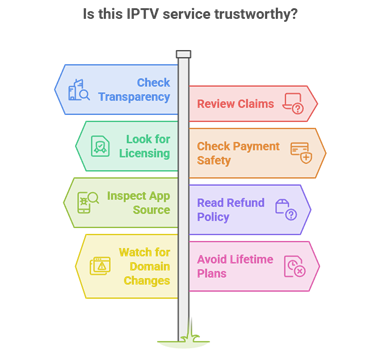
- Check company transparency: Look for a real business name, contact details, support process, and policies.
- Review content claims: Be careful with services promising every premium channel, every sports event, and every movie for one tiny fee.
- Look for licensing language: Legal services usually explain content rights, partnerships, or official distribution terms.
- Check payment safety: Avoid sellers asking only for crypto, gift cards, or direct messages.
- Inspect the app source: Prefer official app stores or well-known IPTV players over unknown APK files.
- Read the refund policy: A trustworthy service should clearly explain billing, cancellation, and support.
- Watch for domain changes: Services that frequently change URLs may be trying to avoid enforcement.
- Avoid unrealistic lifetime plans: Lifetime access to premium content for a small payment is a giant red flag.
If a provider cannot answer where its content rights come from, do not assume everything is fine. Silence is not compliance.
Common Red Flags of Illegal IPTV Services
Illegal IPTV services often sell convenience first and hide risk later. The offer looks attractive because it promises more content for less money. But the lower price can come with unstable streams, sudden shutdowns, poor support, payment risk, malware exposure, and possible legal issues.
| Red Flag | Why It Is Risky | What to Do |
|---|---|---|
| Thousands of premium channels for a very low price | Licensing that much content is expensive | Ask how the provider has rights to distribute it |
| No legal pages or company details | Anonymous providers are hard to hold accountable | Choose transparent services |
| Only sold through WhatsApp, Telegram, or social media | Informal sellers can disappear quickly | Avoid sending payment without verification |
| Unknown APK installation required | Apps outside trusted stores can carry security risk | Use official stores where possible |
| Claims of “100% legal” with no proof | Anyone can write this claim | Look for evidence, not slogans |
| Frequent buffering and channel outages | Unlicensed streams are often unstable | Do not rely on unstable providers |
| Only accepts crypto or gift cards | Refunds and disputes become difficult | Use safer payment options |
What About Free IPTV in Canada?
Free IPTV can be legal or illegal. Some free streaming platforms are supported by ads and have proper content rights. These are usually safer because the business model is clear: advertisers pay for the content, and users watch for free.
However, free playlists that offer premium channels, sports packages, movie channels, and pay-per-view events without permission are risky. Free does not automatically mean legal. In fact, free illegal IPTV can be more dangerous because it may rely on aggressive ads, tracking, malware, or suspicious redirects to make money.
When checking a free IPTV source, ask one simple question: who has the right to show this content, and how is the service funded? If the answer is unclear, step back.
Legal IPTV Options Canadians Can Consider
Instead of chasing risky subscriptions, Canadians can look at safer categories of streaming and IPTV services. These options are not all the same, but they are generally easier to verify than anonymous IPTV sellers.
- Licensed TV providers: Internet-based TV plans from established Canadian TV or telecom providers.
- Official broadcaster apps: Apps owned by broadcasters, networks, or authorized media companies.
- Subscription streaming platforms: Paid platforms that clearly license shows, films, sports, or live channels.
- Free ad-supported streaming services: Legal platforms that show content with ads and proper rights.
- Public or authorized live streams: Streams made available by the content owner or official distributor.
The best option depends on what you watch. Sports fans need to be especially careful because live sports rights are expensive and tightly controlled. If a tiny provider claims to offer every major league and pay-per-view event for pocket change, that is not a secret bargain. It is a warning sign wearing sunglasses.
Risks of Using Illegal IPTV in Canada
The legal risk gets most of the attention, but it is not the only issue. Illegal IPTV can also create practical and security problems for users. Many people discover this only after paying for a long plan and losing access two weeks later.
1. Sudden Shutdowns
Pirate IPTV services can disappear quickly. Domains can be blocked, servers can be taken down, and sellers can stop responding. If you paid for six months or a year, you may have no realistic way to recover your money.
2. Malware and Unsafe Apps
Unknown APK files and unofficial apps can expose your device to malware, tracking, or unwanted permissions. This is especially risky on Android boxes, Fire TV devices, and phones where users may sideload apps without checking the source.
3. Poor Privacy
Unverified providers may collect your email, IP address, payment details, device information, or viewing habits without clear privacy rules. If the service is already ignoring copyright rules, it may not be careful with your data either.
4. No Real Customer Protection
Legal providers usually have customer support, billing records, policies, and complaint channels. Illegal sellers often have none of that. If the service fails, you may only get silence.
5. Possible Copyright Notices
If your internet connection is linked to alleged infringement, you could receive a copyright notice through your internet provider. A notice does not automatically mean you owe money, but it is still a serious signal that your connection has been flagged.
Are IPTV Resellers Legal in Canada?
IPTV reselling is legal only when the reseller is working with a provider that has proper rights to distribute the content. Reselling unlicensed IPTV is risky because the reseller is not just watching. The reseller is helping distribute access to potentially infringing content.
This is where the risk becomes much bigger. If you collect payments, advertise the service, manage customer accounts, or sell access codes, you may be treated very differently from a casual user. You are now part of the distribution chain.
Before becoming an IPTV reseller in Canada, ask for written proof of licensing, business registration, content rights, refund terms, and compliance documentation. If the upstream provider only gives vague answers, do not build a business on it.
IPTV Myths Canadians Should Stop Believing
| Myth | Reality |
|---|---|
| “IPTV is illegal.” | No. IPTV technology is legal. Unauthorized content distribution is the issue. |
| “A VPN makes IPTV legal.” | No. A VPN improves privacy but does not create content rights. |
| “If I pay for it, it must be legal.” | No. Many illegal IPTV services charge subscription fees. |
| “An app store listing proves legality.” | No. A player app can be legal, but the playlist you add may not be. |
| “Free IPTV is always illegal.” | No. Some free ad-supported services are legal when properly licensed. |
| “Only providers can face consequences.” | Providers face higher risk, but users can still face notices, scams, and privacy issues. |
How to Use IPTV Safely in Canada
Using IPTV safely comes down to choosing the right source, protecting your devices, and avoiding services that hide basic information. A clean setup is not complicated. It only requires a little discipline before you pay.
- Use licensed or clearly authorized services whenever possible.
- Download apps from official app stores or trusted developer websites.
- Avoid unknown APK files from random links.
- Do not buy IPTV plans from anonymous social media sellers.
- Use strong passwords for your streaming accounts and home Wi-Fi.
- Read the privacy policy before entering payment details.
- Start with a short plan instead of paying for a long subscription upfront.
- Keep your smart TV, phone, streaming stick, or IPTV box updated.
- Do not share your subscription login publicly.
- Use a VPN for privacy only, not as a way to justify illegal streaming.
What to Do If You Receive a Copyright Notice in Canada
If you receive a copyright notice from your internet provider, read it carefully. Do not panic, but do not ignore it either. A notice means your internet account was linked to alleged infringing activity. It does not automatically mean a court has decided that you infringed copyright.
- Check the date, time, and content mentioned in the notice.
- Secure your Wi-Fi network with a strong password.
- Check whether anyone else in your home used the connection.
- Do not click suspicious payment links inside threatening messages.
- Remember that settlement demands inside notices may not comply with the Notice and Notice rules.
- Speak with a lawyer if the notice is serious, repeated, or connected to a lawsuit.
The main goal is to understand the allegation and stop any risky activity connected to your network. If the notice looks suspicious or demands money immediately, be careful. Scammers love fear. It is practically their business plan.
Final Verdict: Is IPTV Legal in Canada?
IPTV is legal in Canada when the provider has the right to distribute the content. The technology itself is not illegal. Many legitimate services use internet-based delivery to provide live TV, on-demand content, and streaming access.
Illegal IPTV usually involves unauthorized access to copyrighted channels, sports, movies, pay-per-view events, or premium content. These services may look cheap and convenient, but they can bring legal, privacy, payment, and reliability risks.
My practical recommendation is simple: choose transparency over huge promises. If a provider cannot clearly explain who they are, what rights they have, how billing works, and how support is handled, move on. The safest IPTV service is not always the one with the biggest channel list. It is the one you can trust after the payment clears.
FAQs
Is IPTV legal in Canada?
Yes, IPTV is legal in Canada when the provider has proper rights to distribute the content. IPTV becomes illegal when a service streams copyrighted channels, movies, sports, or premium content without authorization.
Can I get fined for using illegal IPTV in Canada?
Most enforcement usually targets operators, sellers, and resellers, but users are not risk-free. A user may receive copyright notices, lose service access, face scams, or become involved in legal action depending on the situation.
Is using an IPTV player app legal?
Yes, IPTV player apps are generally legal. The app only plays content. The legality depends on the playlist, subscription, or stream source you add to the app.
Is an M3U playlist legal in Canada?
An M3U playlist is legal when it contains authorized or lawful streams. It becomes risky when it includes premium channels, sports, movies, or paid content without permission from rights holders.
Does a VPN make IPTV legal?
No. A VPN can improve privacy, but it does not make unauthorized IPTV streams legal. Content rights still matter whether you use a VPN or not.
Are IPTV boxes illegal in Canada?
IPTV boxes and streaming devices are legal when used with lawful apps and content. A box becomes risky when it is preloaded or configured to access unauthorized copyrighted streams.
How do I know if an IPTV provider is legal?
Check whether the provider is transparent, has clear company details, explains content rights, uses safe payment methods, offers proper support, and avoids unrealistic claims such as every premium channel for a very low price.
Is free IPTV legal in Canada?
Free IPTV can be legal when it is ad-supported or offered by authorized platforms. It is risky when it provides premium channels, paid sports, or copyrighted movies without clear permission.
Are IPTV resellers legal in Canada?
IPTV reselling is legal only if the reseller is selling access to content that is properly licensed. Reselling unlicensed IPTV subscriptions carries much higher legal risk than simply watching content.
What should I do before buying an IPTV subscription?
Start with a short plan, verify the provider’s identity, check refund terms, avoid anonymous sellers, use safe payment methods, and make sure the service does not rely on unauthorized premium content.